Lindsay Slater Hannigan conducts sports science on an Olympic stage
Body
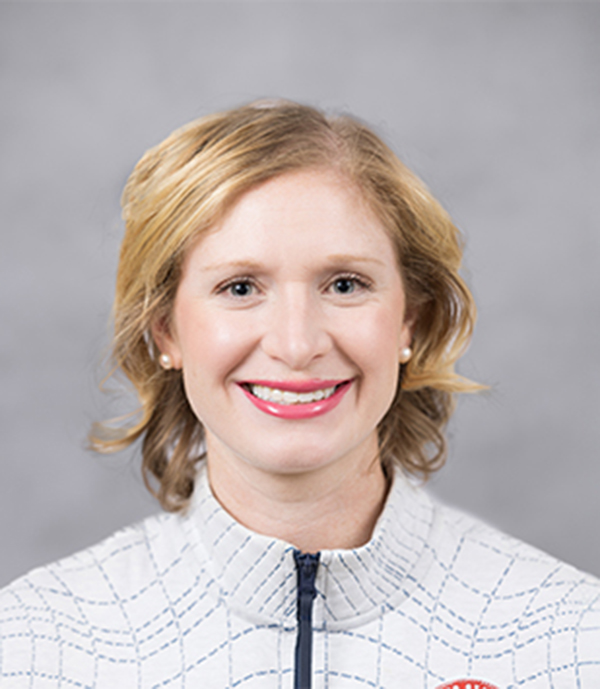
For Lindsay Slater Hannigan, PT assistant professor and sports sciences manager for U.S. Figure Skating, the journey to work with Olympic athletes began with a cold call.
“As a master’s student at The University of Texas at Austin, I reached out to U.S. Figure Skating to express interest in an internship in biomechanics,” she said. She offered to work unpaid during the summer between academic years and continued volunteering throughout her PhD at University of Virginia in exchange for research data.
After earning her doctorate, the organization hired her as a contractor, and today, Hannigan manages U.S. Figure Skating’s sports science program. She uses data to “help the employees, coaches and athletes make performance decisions, injury-prevention decisions and rehabilitation decisions over the course of the season,” Hannigan told the Chicago Tribune from Stamford, Connecticut, where she helped NBC produce its coverage of the 2026 Winter Olympics.
From her grad school days up to today, Hannigan’s work for U.S. Figure Skating has been fast-paced and constantly evolving.
“There are so few employees in high performance that you have to be a team player and contribute where you can,” she said. “National governing bodies are usually understaffed and overworked; everyone is in it for the Olympic passion and wants to help develop athletes. That means some days I may need to help with technical issues and some days I get to be more hands-on with scientific collections.”
Hannigan specializes in jumping athletes and has recently explored how figure skaters can quantify workload. In other sports, measuring repetitions is a straightforward count, like pitches thrown in a single baseball game, but for figure skaters, tracking jumps performed in practice or rotations performed within jumps is more complex.
Hannigan and her colleagues addressed this problem by partnering with a company called 4D Motion Sports to develop wearable technology that measures this data automatically. Sensors worn on the hip can identify an athlete’s jumps based on rotational velocity, then quantify how many jumps are done in a day and at what point it’s best to stop.
“Every athlete thinks working harder means working better,” she told the Tribune. “We’re using the data to identify where they’ve hit their maximum amount of jumps and we start to see a decline in performance — and all athletes had different numbers.”
Hannigan’s path through the sports science field has included some unexpected turns. In the middle of a postdoctoral fellowship studying ACL injury recovery at the Shirley Ryan AbilityLab, a sudden change in mentorship nearly ended her research career. At the eleventh hour, established researcher Dr. Levi Hargrove took a chance on Hannigan and offered her a job assisting him with prosthetics engineering — a discipline far outside her wheelhouse. Taking that chance helped her make novel connections between recovering athletes seeking peak performance and individuals with disabilities navigating everyday challenges.
“I learned so much about individuals with amputation and prosthetics, and the parallels between rehabilitation needs for those with leg amputation and athletes recovering from knee injuries were remarkable. However, no one was studying rehabilitation from amputation to the extent that researchers were studying rehabilitation from ACL injuries.”
The bridge Hannigan built between amputation rehabilitation and athletic recovery has become her own niche in the research, and she wouldn’t have developed such a unique specialization without first taking that bold leap on an unfamiliar fellowship.
“It ended up being the best thing that ever happened to me,” she said. “Life and success are not linear. The best opportunities and learning experiences usually come from the less than ideal circumstances.”