OT researchers awarded $4.5 million grant for community-engaged disability research
Introduction
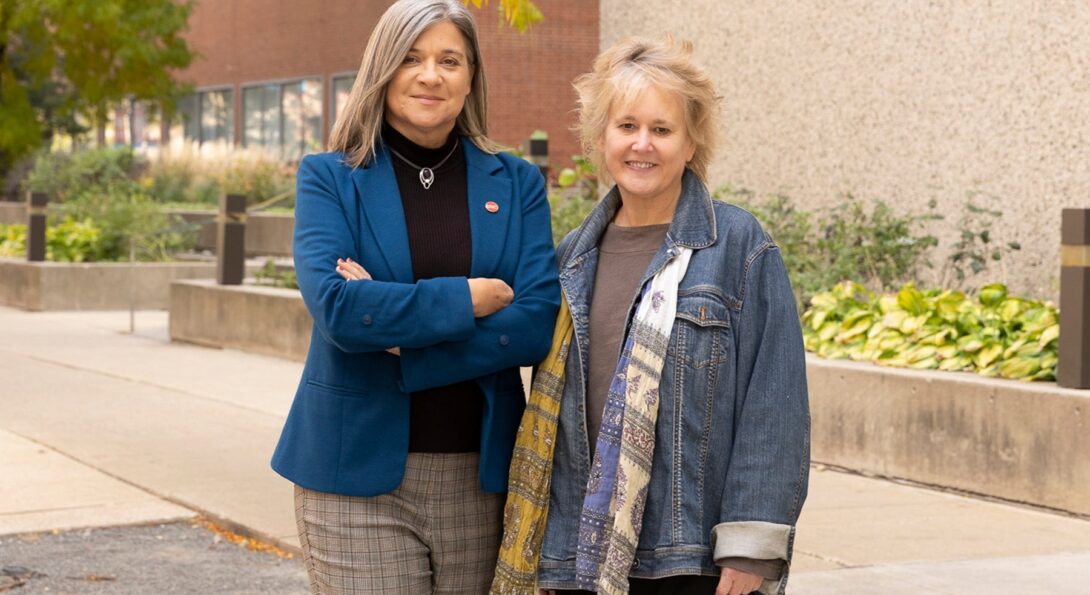
Occupational Therapy department head Susan Magasi ’02 MS OT, ’06 PhD DS and director of graduate studies Joy Hammel have been awarded a five-year, $4.5 million grant from the National Institutes of Health’s National Center for Medical Rehabilitation Research. The grant will fund the ENGAGED: Disability Community Engaged Medical Rehabilitation Research Resource Center, a hub for community-engaged training, outreach and investigation into the social, economic, environmental and policy factors that affect the health of people with disabilities.
“We will be conducting our own independent research as part of the grant, but we will also be creating a variety of resources and initiatives to support other medical rehab researchers interested in integrating community-engaged research practices into their work,” Magasi said. “We know that the vast majority of researchers are not trained in how to do substantive, equitable community-engaged research practices that really involve people with lived experiences.”
Community-engaged research involves participation from community stakeholders, integrating their needs throughout the research process. Buy-in from the relevant community at the outset has been shown to produce more successful research outcomes.
“If you’re focusing on the community’s priorities from the front and throughout the process, not just after you’ve completed it, they’re much more likely to use [the research],” said Hammel. “Interventions and policies that are developed are more effective.”
NIH funds a nationwide system of Medical Rehabilitation Research Resource (MR3) Centers designed to build infrastructure for conducting rigorous, timely medical rehabilitation research. The ENGAGED MR3 Center — which stands for Establish, Network, Generate, Advance, Generate and curate, Empower, and Disseminate — will be one of six centers in the nationwide network.
Research activities in the center will have a broad disability focus, including people with physical, cognitive, mental health, sensory and chronic health disabilities. The work will probe how social determinants of health impact these populations, filling an important research gap, according to Hammel.
The center will also offer mentorship and technical assistance trainings to build capacity both within academia and for community members serving as co-investigators in research.
“It’s not enough to just invite people with disabilities to participate in research,” Magasi said. “We want to help people build their skills and confidence to fully engage as coresearchers and collaborators.”
The center’s leadership team includes scientists who identify as people with disabilities as well as family members of people with disabilities. The grant will also support pilot funding for new community-engaged research initiatives through a national competition.
The OT department has developed a Scholarship of Practice model that has long sought to strengthen the relationship between research, clinical practice and communities. This approach is informed and strengthened by deep connections with AHS' lauded interdisciplinary disability studies PhD program, the researchers said.
“This is what we specialize in. This is what we do,” Hammel said. “Many of us identify as disabled researchers as well as disability activists, and we have incredibly strong relationships with the disability rights communities and many disability organizations and communities in Chicago, but also nationally.”
While Magasi and Hammel are based in OT, they intend the ENGAGED MR3 Center to span disciplinary silos and the divide between research, rehabilitation services and the 70 million people with disabilities living in the United States, they said.
“We’re not just a university in Chicago, but we’re a university for Chicago,” Magasi said. “We’re excited to take that vision nationally and to be able to serve as a as a hub and a resource for how to really do community engagement with disability and other minoritized communities at a rigorous, intentional and equitable level.”
Community-based disability rights organizations and researchers from the University of Texas Health, Houston are also contributing to the project with Magasi, Hammel and other AHS collaborators, including Yolanda Suarez-Balcazar, Tanvi Bhatt, Sarah Parker Harris, Beth Marks '96 PHD DS, Andrew Boyd, Robert Motl and Ed Wang. Karen Cielo from the Center for Clinical and Translational Science and Jeni Hebert-Beirne from the School of Public Health are also collaborators on the project.
This article has been edited for length and clarity by Emily Parenti-Lopez.