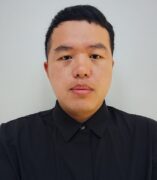
Shuaijie Wang
Research Associate Professor
Physical Therapy
Pronouns: He/Him/His
Contact
Building & Room:
B56 AHSB
Address:
1919 W Taylor St. Chicago, IL. 60612
Office Phone:
Email:
Related Sites:
About
Dr. Wang received his BS and MS degrees in Electrical Engineering and Automation from Xi'an Jiaotong University, and his PhD degree in Mechanical Engineering from the University of Chinese Academy of Sciences in 2014. He is currently a Research Associate Professor and Co-Director of the Cognitive, Motor, and Balance Rehabilitation Laboratory in the Department of Physical Therapy. Dr. Wang’s research expertise is in balance and gait rehabilitation for older adults. His work investigates the biomechanical and neuromechanical mechanisms underlying functional mobility and fall risk, develops interventions to improve balance control and prevent falls, and designs AI-driven algorithms for assessing and predicting health outcomes. Over the past decade, he has led studies examining repeated perturbation training using treadmill and movable platform paradigms, as well as the neuromuscular mechanisms underlying slip- and trip-related falls, and has published over 50 peer-reviewed papers.
Selected Grants
AHS Interdisciplinary Pilot Grant Program, Development of fall-risk prediction model for older adults using artificial intelligence approaches, PI
Midwest Roybal Center Grant, Innovative Cognitive-Motor Training for Prevention of AD/ADRD: Leveraging Technology into CogXergaming, PI
National Institutes of Health R01, Neuromechanisms of falls in older adults with MCI: Targeting assessment and training of reactive balance control, Co-I
National Institutes of Health R01, Aging and task-specific training to reduce falls, Co-I
Selected Publications
- Wang, S., Omar, K. S., Miranda, F., & Bhatt, T. (2025). Automatic gait event detection in older adults during perturbed walking. Journal of NeuroEngineering and Rehabilitation, 22(1), 40.
- Arena, R., Wang, S., Pronk, N. P., Woodard, C., & Bhatt, T. (2025). The Forcing Factors of Physical Inactivity and Obesity in the United States–An Artificial Intelligence Analysis of an Ecological Framework. The American journal of medicine.
- Wang, S., Purohit, R., Van Criekinge, T., & Bhatt, T. (2024). Neuromuscular mechanisms of motor adaptation to repeated treadmill-slip perturbations during stance in healthy young adults. IEEE Transactions on Neural Systems and Rehabilitation Engineering.
- Wang, S., Nguyen, T. K., & Bhatt, T. (2023). Trip-Related Fall Risk Prediction Based on Gait Pattern in Healthy Older Adults: A Machine-Learning Approach. Sensors, 23(12), 5536.
- Wang S, Pai Y C, Bhatt T. Is there an optimal recovery step landing zone against slip-induced backward falls during walking? [J]. Annals of biomedical engineering,2020
- Wang S, Varas-Diaz G, Dusane S, et al. Slip-induced fall-risk assessment based on regular gait pattern in older adults[J]. Journal of Biomechanics, 2019: 109334
- Wang S, Liu X, Lee A, et al. Can Recovery Foot Placement Affect Older Adults’ Slip-Fall Severity? [J]. Annals of biomedical engineering, 2017, 45(8): 1941-1948.