KN and public health faculty tour NHANES mobile centers visiting Illinois Medical District
Introduction
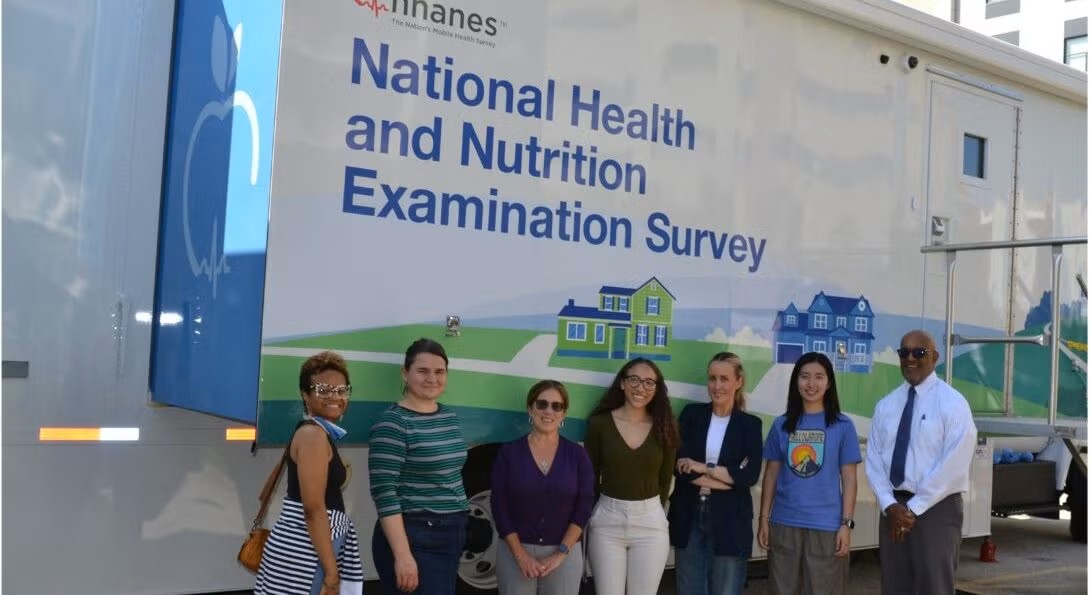
Faculty from the Department of Kinesiology and Nutrition and UIC’s School of Public Health recently toured the National Health and Nutrition Examination Survey (NHANES) mobile examination center temporarily located in the Illinois Medical District. AHS participants included KN professor and associate head Giamila Fantuzzi, instructor Sherri Ambrose, and clinical assistant professors Sofia Cienfuegos and Kirsten Straughan
“Walking through the mobile units and seeing firsthand how the data is collected was incredibly insightful,” Straughan said. “I appreciated learning about the intentional efforts to ensure the data represent all Americans — across rural and urban communities, races, ethnicities, genders and more. It was also very impressive to see a DEXA machine and a fully equipped laboratory inside a mobile facility!”
NHANES is conducted by the Center for Disease Control and Prevention’s National Center for Health Statistics. The survey was first conducted in the early 1960s after the passing of the National Health Survey Act, and since the late 1990s, it has been used more often and across broader swaths of the country. The survey consists of three main sections — health interviews, health examinations and lab tests — all of which can be performed in the portable NHANES examination trucks.
Each year, five NHANES examination vehicles travel to four U.S. locations for eight-week screenings of the local population, collecting approximately 200 screenings per stop. The locations and individuals chosen for the NHANES examination are selected based on statistical models and the U.S. Census primary sample units to ensure representative data. Participants are recruited via telephone and can receive support for transportation and childcare should they choose to be screened.
Hundreds of tests can be run within a few hours in each truck, which hosts a six-person team consisting of a nurse, a biomedical equipment specialist, a dental hygienist, a bone densitometry technologist, a medical lab technician and a medical lab scientist. Patients can be screened for common conditions such as allergies, diabetes, anemia, obesity, hearing or vision loss and osteoporosis. A dietician also visits participants’ homes to learn more about their behavioral health, medications and at-home air and water quality. Participants receive a copy of all their test results to help inform their personal health decisions.
The data collected through NHANES are publicly available on the CDC website, with updates posted every two years. The data include reports and some interactive data visualizations, such as tables and graphs.
The public availability of NHANES data plays an important role in public health practice and science. Researchers use the survey data to monitor health and nutrition trends, identify undiagnosed coditions and environmental exposures, understand disease risk and design effective health programs and services.
This article has been edited for length and clarity by Emily Parenti-Lopez.